Learning the Games
How a roulette wheel is laid out, and why the order looks random
The numbers around a wheel head are not in counting order, and they are not scattered at random either. The ring is arranged so that colours, high numbers and odd numbers are spread as evenly as the geometry allows.
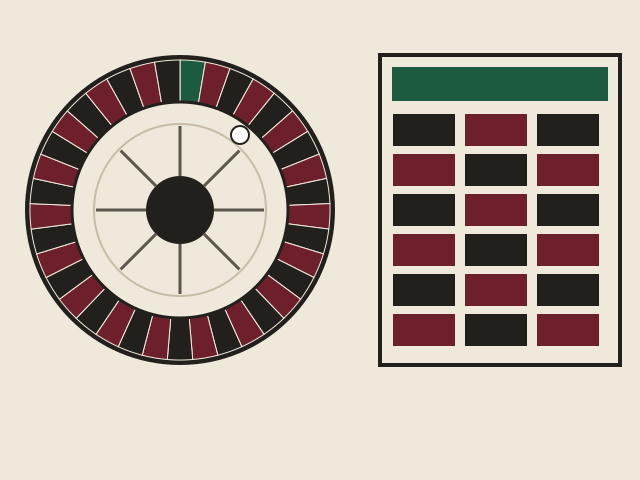
Look down at a single-zero wheel and the first thing that fails to appear is any sequence you would recognise. One is not beside two. Thirty-six is not beside thirty-five. The green zero sits at the top of the ring and the numbers run away from it in an order that seems to have been shaken out of a bag.
It was not shaken out of anything. The ring on a single-zero wheel holds thirty-seven pockets: the numbers one to thirty-six, and a single green zero. The order is fixed, it is the same on every wheel of that type, and it is built to satisfy several constraints at once.
The first constraint is colour. Red and black alternate the whole way round the ring, with the green zero as the only interruption. That alternation is why the wheel reads as a band of stripes when it is spinning rather than as blocks of one colour.
The second is magnitude. The eighteen low numbers and the eighteen high numbers are distributed so that a high number generally sits beside a low one. Any arc of the ring you care to isolate contains a rough mix of both, rather than a run of small numbers on one side and large ones on the other.
The third is parity, and it is the constraint that gives the ring its scrambled look. Odd and even are also spread across the ring, and satisfying colour, magnitude and parity at the same time forces the sequence into an order that no simple rule reproduces from memory.
The consequence is easy to state and easy to mistake. Because the neighbours of any pocket differ in colour, size and parity, a section of the wheel does not favour any of the outside propositions. A ball landing in one arc rather than another tells you nothing about red or black, high or low, odd or even.
That is the point of the arrangement. It removes the possibility that a mechanical bias towards one region of the ring would translate into a bias towards one of the even-money propositions on the cloth. A wheel that ran the numbers in counting order would have exactly that flaw: a lazy rotor favouring one arc would favour the low numbers with it.
The double-zero wheel used in many rooms takes the same idea and applies it to thirty-eight pockets, with a green zero and a green double zero placed opposite one another and a different ring order. The design intent is the same; the arithmetic that follows from the extra green pocket is not, and that is the subject of a separate entry at the Rules Desk.
None of this is a system, and the layout offers nothing to exploit. It is worth understanding for the opposite reason: it explains why the arrangement of the cloth, which groups numbers into neat columns and dozens, has nothing at all to do with the arrangement of the wheel that decides them.