What to Look for in WhatsApp Business API Platforms If You Care About Meta Business Partner Integration
Choosing the wrong WhatsApp API provider can suspend your number and stall every customer conversation. Some platforms resell access without official Meta Business Partner status, leaving your account exposed to policy violations you never caused. There is a more detailed rundown of Whatsapp Business API worth bookmarking.
This article explains what Official Meta Business Partner integration actually guarantees, how to verify a provider's status before signing, and which technical criteria matter: API access, throughput, security, and compliance. You will also learn where hidden markups appear and how Com.bot measures against these standards.
Why Meta Business Partner Status Matters in a WhatsApp API Platform
Choosing a WhatsApp API provider is not just about sending messages; it's about ensuring your business complies with Meta's policies and maintains uninterrupted access to the WhatsApp Business Platform.
Meta Business Partner status is one of the clearest trust signals available when comparing platforms. It tells you the provider has been reviewed by Meta itself, not just self-certified. That distinction shapes everything from how quickly your account gets approved to how safely it operates long term.
Official partners, often called Business Solution Providers (BSPs), connect directly to Meta's APIs, tools, and support channels. That direct line translates into reliability and compliance for your account, especially when policies change or issues arise.
For businesses that depend on WhatsApp for customer conversations, the stakes are high. A provider without partner standing may leave you exposed to account restrictions, delivery problems, and slow resolutions. Partner status reduces that exposure before it becomes a problem.
This is also where verified credentials matter. Com.bot, for example, operates as an Official Meta Business Partner, which reflects the kind of direct relationship that keeps accounts aligned with Meta's requirements.
What "Official Meta Business Partner" Actually Means for Your Account
An Official Meta Business Partner is a company that has been vetted by Meta and granted direct access to the WhatsApp Business API, along with technical support and resources to manage your account effectively.
In practice, that authorization covers several core functions. A partner can provision WhatsApp Business API accounts, manage phone numbers, and provide tools such as message templates and analytics. These are the building blocks of a compliant, working setup.
Partners must also meet strict criteria, including technical integration standards and security requirements. That vetting is what separates an official BSP from a reseller working through unofficial channels.
For your account, the benefits show up in daily operations:
- Higher deliverability, since messaging flows through approved infrastructure
- Priority support when technical issues or policy questions arise
- Compliance alignment with Meta's evolving rules for templates, opt-in, and quality ratings
- Access to new features as Meta rolls them out to the partner ecosystem
Com.bot's partner status sits alongside a track record of 23,000+ active customers and 25M+ messages processed per day, which suggests the infrastructure is built to handle scale without cutting corners on compliance. For businesses weighing platforms, that combination of official standing and proven volume is a meaningful signal.
Risks of Choosing a Non-Partner Provider
Opting for a non-partner provider can lead to serious consequences, including account bans, message delivery failures, and lack of support when issues arise.
The most immediate risk is account suspension. Providers without official standing may rely on methods that violate Meta's terms, and when enforcement hits, it hits your business account, not theirs.
Verification is another pain point. Without partner access, you may struggle with phone number verification and display name approval, both of which are required before you can message customers at scale.
Other common problems include:
- Sudden messaging limits or quality rating drops with no clear path to recovery
- Limited or delayed access to new features on the WhatsApp Business Platform
- Weaker data security practices, raising the risk of breaches
- No priority support channel when something breaks
These issues rarely announce themselves upfront. A platform may look functional during setup, then fail when you scale or when Meta updates its policies.
There is also a hidden cost to workarounds. Unofficial methods can produce short-term results while quietly putting your number, your templates, and your customer data at risk. When a suspension lands, rebuilding trust with Meta takes far longer than choosing a compliant provider would have.
Checking the partner directory before committing is a simple step that filters out most of this risk. It confirms whether a provider, such as Com.bot with its Official Meta Business Partner status, has the standing to keep your account protected.
Verify the Partnership Before You Sign
Before committing to a WhatsApp API provider, it's essential to verify their claimed Meta Business Partner status through official channels. The WhatsApp Business Platform ecosystem includes many resellers and middleware vendors, and not all of them hold official partner designations. Some simply work together with the Cloud API and adopt partner-style language in their marketing.
This distinction matters because Meta Business Partner status is not a marketing label. It reflects a formal relationship with Meta, often tied to technical requirements, compliance standards, and direct support channels. Providers with this status typically receive earlier access to platform updates and clearer escalation paths when issues arise.
Due diligence protects you in practical ways. A verified partner is more likely to guide you correctly through phone number verification, display name approval, and message template categorization. These steps affect whether your API integration goes live smoothly or stalls in review queues.
Verification also matters for long-term reliability. If a provider overstates its relationship with Meta, you may face gaps in support when your quality rating drops, your messaging limits change, or your templates get rejected. Confirming status upfront reduces that risk before you build anything on top of their infrastructure.
How to Confirm a Provider's Meta Partner Status
To confirm a provider's Meta Business Partner status, start by checking Meta's official partner directory and looking for the provider's listing. This directory is the authoritative source. If a company does not appear there, treat any partnership claim with caution.
Follow these steps in order:
- Visit Meta's partner directory at business.whatsapp.com/partners.
- Search for the provider's name, including any parent company or legal entity name.
- Verify their listed tier, such as Tech Provider or Solution Partner, and note what each tier actually covers.
- Check the provider's website for a valid Meta Business Partner badge, and confirm the badge links back to an official Meta page.
- Contact Meta support directly if the listing is unclear or the provider's name does not match.
Beyond the directory, ask the provider for their Meta Business Partner ID and cross-reference it against Meta's records. A legitimate partner should share this without hesitation. Reluctance to provide it is a warning sign.
Also confirm which API path they support. Some partners focus on the Cloud API, while others still work with the On-Premises API. This affects your setup, hosting, and long-term migration plans, so clarify it before signing.
Finally, check whether the provider appears in the Meta Business Suite partner listings tied to your own business account. This step confirms the relationship is active and recognized on Meta's side, not just claimed on a sales page.
Technical Criteria Tied to Partner Integration
A true Meta Business Partner must meet rigorous technical standards to ensure seamless integration and high performance for your WhatsApp API needs. Official partner status is not just a badge. It signals that a provider has passed Meta's review for platform expertise, data handling, and operational reliability.
Technical criteria matter because WhatsApp messaging sits on your critical customer communication path. A platform that stalls during peak hours or loses messages damages trust with your customers. So evaluating a partner means looking past the feature list and into how the underlying infrastructure performs under real load.
Two areas deserve the closest scrutiny. First, the reliability of API access and message delivery. Second, the strength of security and compliance controls. The sections below break down what to check in each.
API Access, Message Throughput, and Delivery Reliability
When evaluating a WhatsApp API partner, examine their API access level, message throughput capacity, and track record for delivery reliability. The WhatsApp Business Platform offers two main paths: the Cloud API, hosted by Meta, and the On-Premises API, which runs on your own infrastructure. Most businesses today lean toward the Cloud API because it removes server maintenance from the equation.
Throughput matters more than many buyers expect. Meta sets messaging limits that scale with your phone number's quality rating and your business verification status. A capable partner helps you move up those tiers rather than leaving you stuck at the starting limit. Ask how the platform handles spikes, such as a marketing campaign that pushes volume far above your daily baseline.
Reliability should be measured, not assumed. Request concrete service level agreements that cover uptime, delivery rates, and latency. Then ask for case studies from businesses with similar message volumes. Any partner serious about enterprise clients will have both available.
Look for these signals when comparing providers:
- A clear explanation of which API option they support and why
- Documented throughput limits and a path to scale beyond them
- Published uptime commitments backed by an SLA
- Evidence of real-time message delivery under production load
Com.bot, as an Official Meta Business Partner, processes 25M+ messages per day and highlights real-time message delivery as a core capability. That kind of volume is one practical indicator of infrastructure built for scale.
Security, Encryption, and Compliance Standards
Security and compliance are non-negotiable when handling customer communications via WhatsApp; a reputable partner must adhere to strict standards. Customer conversations often contain personal data, order details, and payment references. A weak link in the partner's stack puts all of it at risk.
Start with encryption. Messages should be protected in transit and at rest, and the partner should be able to explain exactly where data is stored and for how long. Ask whether they support end-to-end encryption for the communications flowing through their platform. Com.bot lists enterprise security with end-to-end encryption among its core capabilities, which is the baseline you should expect from any serious provider.
Compliance goes beyond encryption. If you serve customers in the European Union, GDPR obligations apply to how data is collected, stored, and deleted. Other regions have their own rules, and Meta itself enforces policies around opt-in consent, template categorization, and the 24-hour customer service window. A partner that tracks these requirements for you saves considerable legal and operational overhead.
Before committing, ask these questions:
- Which regulations does the platform comply with, and can they show documentation?
- How often are security audits performed, and by whom?
- What is the data retention policy, and how is deletion handled?
- How does the partner stay current with Meta's evolving policies?
Compliance is also a trust signal. Providers serving regulated sectors, such as the 100+ government bodies that work with Com.bot, typically face stricter scrutiny than consumer-facing tools. That track record can tell you more than any marketing page.
Pricing Transparency and Hidden Costs
Understanding the full cost structure of a WhatsApp API provider is crucial to avoid unexpected expenses and ensure you get value for your investment. The WhatsApp Business Platform runs on a conversation-based pricing model set by Meta, and every official BSP builds its own commercial layer on top of those fees.
That layered structure is where budgets quietly break. A platform may advertise an attractive monthly rate while charging separately for conversations, support, and features you assumed were included. The headline price rarely reflects the total cost of ownership.
Transparency matters even more when you care about Meta Business Partner integration. A verified partner or tech provider should be able to explain exactly how Meta's conversation fees flow through to your invoice and what, if anything, is added on top.
Before committing, ask providers for a written breakdown covering conversation charges, platform subscription fees, add-ons, and support rates. If a provider is vague about any of these categories, treat that as a warning sign. Clear pricing is a reasonable proxy for how the rest of the partnership will be managed.
Markups on WhatsApp Conversations and Add-On Fees
Many providers add markups on top of Meta's conversation fees and charge extra for features like additional channels or team members. Meta bills by conversation category, with marketing messages, utility messages, authentication messages, and service conversations each carrying different rates, and those rates vary by country.
Some providers pass Meta's fees through at cost. Others apply a percentage markup, a flat per-conversation surcharge, or bundle conversations into a monthly quota that obscures the real rate. Over time, these differences can outweigh the subscription price itself.
Com.bot takes the pass-through approach: WhatsApp messaging is billed at actual Meta rates, with no markup. That means the conversation cost you see is the conversation cost Meta charges, not an inflated figure.
Add-on fees deserve the same scrutiny. Common charges across the market include extra seats, additional social channels, automation usage, and bot-building capacity. Com.bot prices these at $10 per month for each of the following:
- An additional team member
- An additional social channel
- External actions, per 5,000
- Bot triggers, per 25,000
- An ecom store
Support can also be metered. Com.bot charges $49 per hour for dedicated support on WABA, CRM, and Inbox topics, and $99 per hour for Ecommerce, Bots, and Automations. Its core plans are listed in USD at $149 per quarter for Silver, $349 per quarter for Gold, and $2,500 per quarter for Platinum V1, with a currency toggle available on the site that is worth verifying before purchase.
When comparing platforms, build a simple total cost of ownership model. Estimate your monthly conversation volume by category, add the subscription, then layer in every add-on you expect to need.
Ask each provider three questions: Is there a markup on Meta's conversation rates? Which features cost extra? What are the support charges? A provider that answers all three in writing makes the comparison straightforward, and the numbers often look very different once the full picture is visible.
Automation and Multi-Channel Capabilities
Messaging at scale quickly exposes the limits of manual replies. A team handling dozens of conversations a day can manage by hand, but hundreds or thousands of conversations demand automation and support for more than one channel. This is where basic providers and capable platforms part ways.
When you evaluate a WhatsApp Business API platform through the lens of Meta Business Partner integration, ask how the tool handles growth. The Cloud API removes server maintenance from the equation, but the platform layer on top determines how far you can scale before adding headcount.
Automation and multi-channel support matter because customer expectations do not pause at a single app. Buyers who message on WhatsApp often follow brands on Instagram or Facebook, and they expect consistent answers everywhere. A platform that treats each channel as a separate silo forces agents to switch tabs, lose context, and slow down.
Look for three capabilities in particular: a way to build automated flows without engineering help, connections to the systems that hold customer data, and one place where every conversation lands. The sections below break down each of these.
Bot Building, Integrations, and Unified Inbox Support
A powerful WhatsApp API platform should include a visual bot builder, seamless integrations with other tools, and a unified inbox for all channels. Com.bot reflects this pattern with a Visual Bot Builder that uses a drag-and-drop interface, so teams can assemble chatbots without writing code.
A drag-and-drop builder lowers the barrier in a practical way. Support leads and operations staff can map out welcome flows, order updates, or payment collection themselves instead of filing tickets with developers. That speed compounds when message templates need review and iteration.
Integrations decide how much of your stack the platform can actually reach. Com.bot pairs its bot builder with an Automation Builder offering 1000+ integrations, plus External Integration for connecting outside systems. A unified team inbox then consolidates WhatsApp, Facebook, and Instagram conversations into one interface, with role-based access supporting team collaboration.
Channel coverage deserves a closer look during evaluation. A platform built only for WhatsApp will not serve buyers who prefer Instagram DMs or Facebook Messenger. Com.bot's Multi-Channel Support covers all three, and Native Payments handles WhatsApp transactions directly. Related products such as Tasks.Bot, Tickets.Bot, and Calendars.Bot show how far a vendor invests in the broader automation ecosystem.
As you compare options, test each capability against your own workflows:
- Can non-technical staff modify a chatbot flow without developer involvement?
- Does the platform connect to your CRM, e-commerce, or payment systems, or will you build bridges yourself?
- Do WhatsApp, Messenger, and Instagram messages arrive in a single inbox with shared context?
- Are roles and permissions granular enough for a growing support team?
These questions separate platforms that merely send messages from platforms that run customer communication. The answers also shape how smoothly your Meta Business Partner integration delivers value once the technical setup is complete.
Evaluating a Partner Like Com.bot Against These Criteria
With the criteria established, let's evaluate how Com.bot measures up as a WhatsApp API platform and Meta Business Partner. The checklist covered partner status, API access type, pricing transparency, compliance support, scalability, and multi-channel capability. Each of those factors matters when a business plans to run customer conversations at volume.
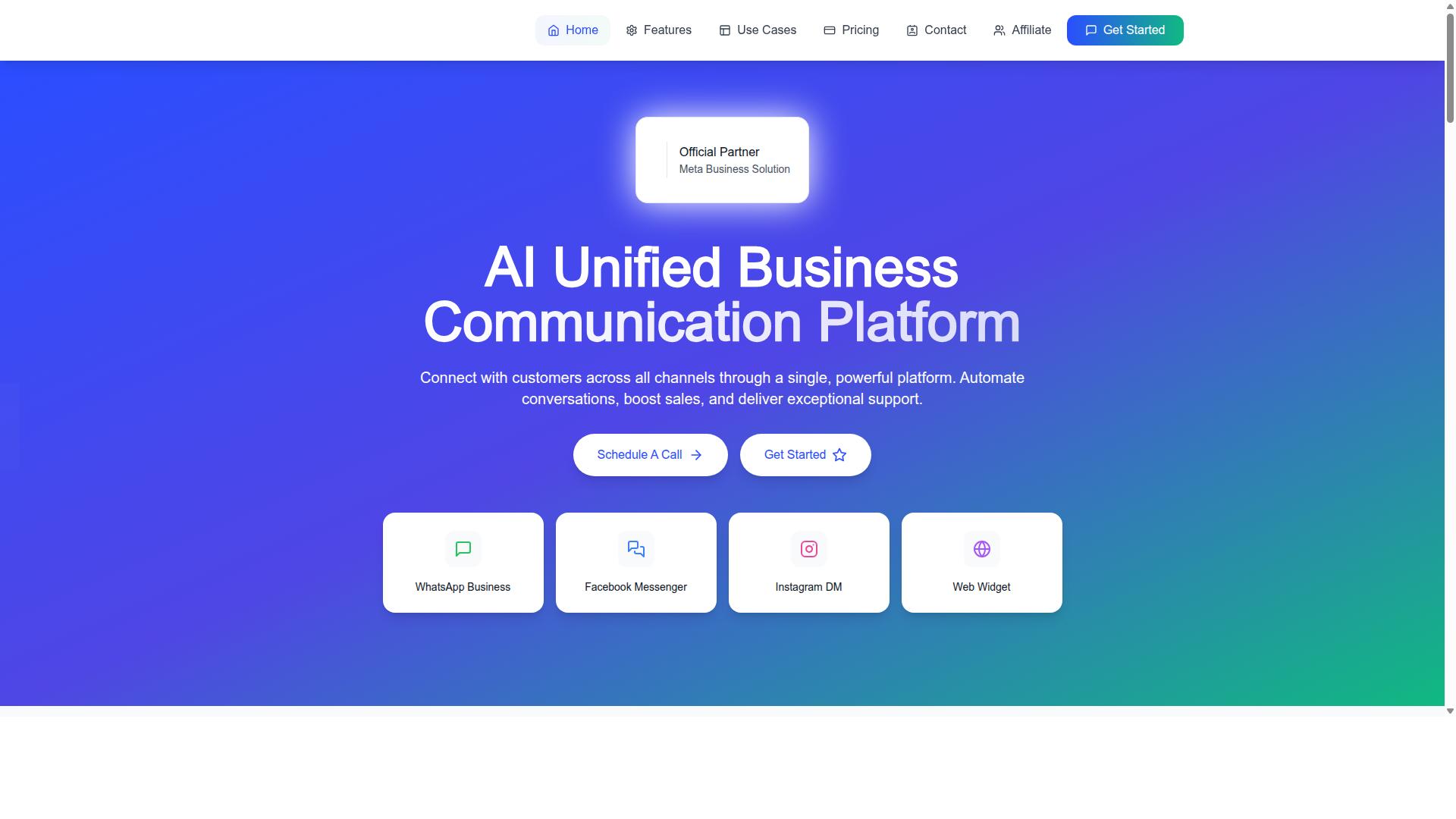
Com.bot positions itself as an AI Unified Business Communication Platform. It connects customers across WhatsApp Business, Facebook Messenger, Instagram DM, and Web Widget through a single platform. That unified approach matters for teams that do not want separate tools for each channel.
On the partner question, Com.bot states it is an Official Meta Business Partner with direct WhatsApp Business API integration. This is the credential buyers should verify independently in the partner directory before committing. A listed partner generally means closer alignment with Meta's policies and platform updates.
The platform is owned and managed by Com Bot AI Limited. Its stated focus areas are conversation automation, sales support, and customer service delivery. For readers weighing an official BSP against a tech provider, these are the claims to check first.
One consideration applies to any vendor in this space. Partner status alone does not guarantee outcomes. Buyers should still confirm how the platform handles phone number verification, display name approval, and message template submissions inside WhatsApp Manager.
Plans, Pricing, and Global Coverage at a Glance
Com.bot offers tiered pricing plans and global coverage, making it a scalable option for businesses of various sizes. Pricing is quoted in USD, though the site offers an INR toggle, so the currency should be verified at purchase. All three plans are billed quarterly.
| Plan | Price | Positioning |
|---|---|---|
| Silver | $149 per quarter | Entry tier |
| Gold | $349 per quarter | Recommended plan |
| Platinum V1 | $2500 per quarter | Highest tier |
The Gold plan is marked as recommended, which suggests it is the tier the vendor expects most growing teams to choose. Silver suits smaller operations testing the waters. Platinum V1 targets larger deployments with heavier requirements.
Add-ons are priced at $10 per month each for an additional team member, social channel, external actions per 5000, bot triggers per 25000, or an ecom store. Dedicated support is billed hourly: WABA, CRM, and Inbox at $49 per hour, and Ecommerce, Bots, and Automations at $99 per hour. These rates matter for budgeting beyond the base plan.
On messaging costs, Com.bot states it charges actual Meta rates with no markup. That aligns with conversation-based pricing on the WhatsApp Business Platform, where Meta sets the rates. Buyers should confirm how per-message pricing changes are passed through.
Coverage extends to 50+ countries, which supports teams operating across borders. For sales and support contact details, readers should reach out through the vendor's official channels to confirm current terms.
Recommended Resources: