Floor Notes
What independent testing of a number generator actually measures
Testing a random number generator means running its output through a battery of statistical checks. Each check looks for one specific way a sequence can fail to be random.
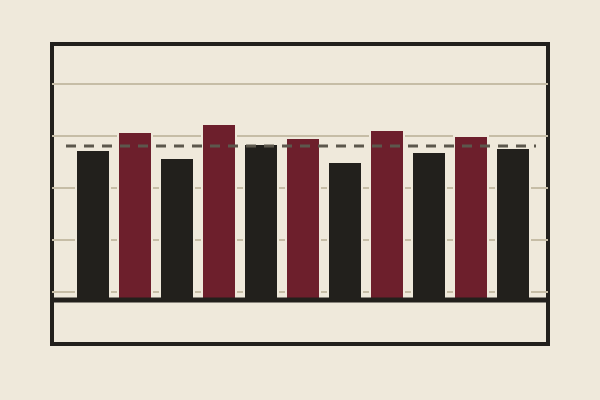
A random number generator is a piece of software, and software can be examined. What examination means in practice is narrower and more interesting than the phrase suggests.
The starting point is that no finite sequence can be proved random. What can be done is the reverse: a sequence can be shown to fail. A test battery is a collection of ways to fail, applied one after another to a very large sample of output.
The simplest family of checks is frequency. Over a long run, each possible outcome should appear about as often as every other, within the margin that chance allows. A generator that produces one value noticeably too often fails here and needs no further examination.
Serial correlation is next. Given one outcome, the following outcome should carry no information. Tests look for repeating gaps, for values that follow each other more often than they should, and for longer cycles that only become visible across millions of draws.
Distribution shape matters as much as frequency. Runs of identical values, the spacing between repeats, and the way values cluster in a sequence all have known expected behaviour. Real randomness produces long runs sometimes; a generator that never produces them is as suspicious as one that produces too many.
Alongside the statistics sits a different kind of examination entirely: reading the code. Seeding is the usual weak point. A generator with excellent statistical properties that is seeded predictably is not unpredictable, because the sequence can be reproduced by anyone who can guess the seed.
It is worth being precise about the limits. A test result describes a sample of output from a particular build under particular conditions. It does not describe the game logic that consumes the numbers, it does not describe how a result is presented to a player, and it does not describe any specific spin or hand.
That distinction is routinely blurred. Statistical testing is a check on one component, and it is a genuinely useful one. It is not a guarantee about an outcome, and it was never designed to be.