Table Talk
The sequence of play at a busy craps table
Craps looks chaotic because several things happen at once and none of them are announced. The order underneath is short and fixed.
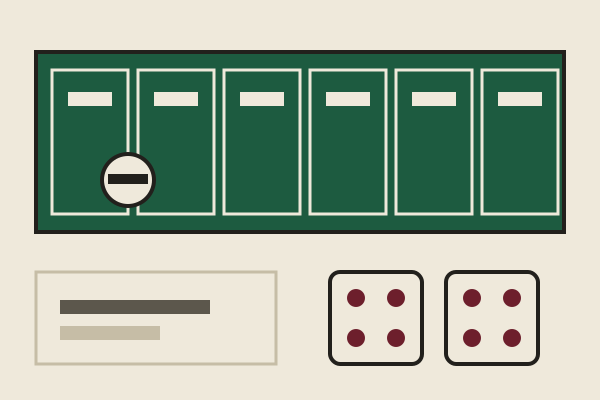
A busy craps table is the loudest thing on a floor and the hardest to read from outside. The noise conceals a sequence that is actually quite short.
A round begins with a come-out roll. The white puck sits off to the side with its dark face up, which is the table's way of stating that no point has been established yet.
On that first roll, the round can end immediately. Certain totals resolve it at once in one direction, and a specific pair of totals resolves it in the other. If none of those appear, the number rolled becomes the point.
The crew then moves the puck onto that number and turns it light side up. From that moment the table has a single question: will the point be repeated before a seven appears? Every subsequent roll is read against that question.
The crew is three people with distinct jobs, which is the second source of apparent chaos. A stickperson controls the dice and calls each roll. Two dealers work the ends of the table, handling wagers, paying and collecting for the players in front of them. A boxperson sits opposite the stick supervising the chips.
The order of operations after a roll is rigid. The stick calls the number and pulls the dice back to the centre. Losing wagers are collected first. Winning wagers are paid next, working out from the middle of the layout. Only when the layout is clear does the stick release the dice for the next roll.
That is why reaching across the layout mid-sequence causes trouble, and why the crew will ask for hands clear before the dice are pushed out. It is a timing constraint, not etiquette for its own sake.
The customs that surround the game follow from the same source. Wagers are placed during the window between rolls, not during one. Chips are set down on the layout rather than handed over. The dice are expected to reach the far wall, which is a fairness rule about the throw rather than a superstition.
Once the puck is understood as a state marker, the rest of the table becomes readable. Dark side up means a round is beginning. Light side up on a number means the table is waiting to see which of two outcomes arrives first.